
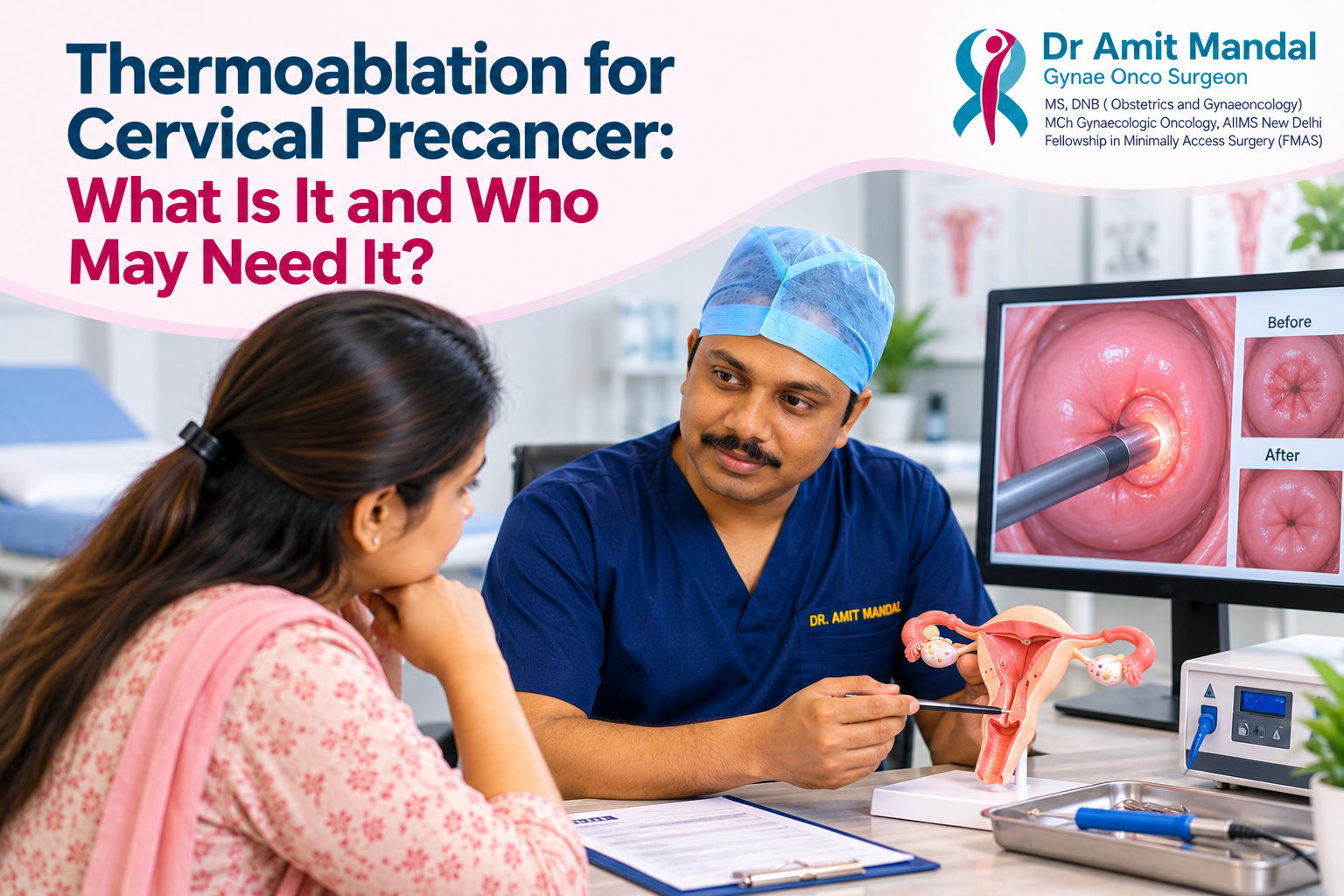
Thermoablation for Cervical Precancer: What Is It and Who May Need It? | Dr. Amit Mandal
Posted on: Sep 20, 2026
A woman may hear the word “precancer” after an HPV test, PAP smear, visual examination or biopsy and immediately wonder what happens next. Does every precancerous cervical lesion require surgery? Is there a way to treat the abnormal area without removing a larger piece of the cervix?
In selected cases, thermal ablation, also called thermoablation or thermocoagulation, can be used to treat cervical precancerous lesions.
The treatment works by applying controlled heat to the abnormal area of the cervix, destroying the affected tissue. But thermoablation is not simply a treatment that can be chosen because it is less invasive or convenient. A woman first needs appropriate assessment to determine whether the lesion is suitable for ablative treatment.
The World Health Organization recognises thermal ablation as an option for treating eligible cervical precancerous lesions. WHO describes the treatment as an ablative procedure using a heated probe applied to the cervix. :contentReference[oaicite:0]{index=0}
For a woman who has recently been told that she has a cervical precancerous lesion, the more important question is therefore not simply “Is thermoablation available?” but “Is thermoablation appropriate for my particular cervical lesion?”
What Is Thermoablation?
Thermoablation is a treatment that uses controlled heat to destroy abnormal cervical tissue.
It is also known as thermal ablation, thermocoagulation or, in some medical literature, cold coagulation.
During the procedure, a heated metal probe is applied to the abnormal area of the cervix for a controlled period. WHO's guideline describes thermal ablation as the application of a heated probe, with treatment commonly involving applications of around 20 to 40 seconds, sometimes repeated depending on the lesion and treatment protocol. :contentReference[oaicite:1]{index=1}
The objective is to destroy the abnormal cervical tissue so that healthy tissue can subsequently replace it.
Thermal ablation is different from an excisional procedure because the abnormal tissue is destroyed rather than removed as a specimen for histopathological examination.
Why Is Thermoablation Used for Cervical Precancer?
Cervical cancer usually develops through a process in which abnormal cells can appear before invasive cancer develops.
These precancerous changes can sometimes be detected through cervical screening and treated before they progress.
WHO considers screening and treatment of cervical precancer an important part of cervical cancer prevention. :contentReference[oaicite:2]{index=2}
Thermoablation is one of the treatment approaches that can be used for appropriately selected cervical precancerous lesions.
The value of treatment at this stage is that the abnormal tissue can be addressed before invasive cancer develops. However, the procedure is suitable only when the lesion meets the required clinical criteria.
Does Every Cervical Precancerous Lesion Need Thermoablation?
No.
This is one of the most important points for patients to understand.
A diagnosis of cervical precancer does not automatically mean that thermoablation is the right treatment.
The doctor needs to assess factors such as the location and extent of the lesion, whether the entire lesion can be seen, whether the transformation zone is adequately visualised and whether there is any suspicion of invasive or glandular disease.
WHO guidance states that ablative treatment is appropriate only when specific eligibility criteria are satisfied. If invasive cancer or glandular disease is suspected, ablative treatment should not be used as a substitute for appropriate diagnostic evaluation. :contentReference[oaicite:3]{index=3}
This is why a proper examination and, when indicated, colposcopy and biopsy are important before deciding on treatment.
Who May Be Suitable for Thermoablation?
Eligibility depends on the clinical findings rather than simply on the patient's age or the fact that a PAP smear was abnormal.
In general, ablative treatment may be considered when the cervical precancerous lesion can be adequately assessed and the required treatment criteria are fulfilled.
WHO's guidance includes criteria such as:
- There should be no suspicion of invasive cervical cancer.
- There should be no suspicion of glandular disease such as adenocarcinoma or adenocarcinoma in situ.
- The transformation zone should be sufficiently visible.
- The complete lesion should be visible.
- The lesion should not extend into the endocervical canal in a way that makes adequate treatment inappropriate.
These criteria are important because thermal ablation destroys tissue at the treatment site. If an area cannot be adequately visualised or there is concern about a more serious diagnosis, another form of evaluation or treatment may be required. :contentReference[oaicite:4]{index=4}
What Happens Before Thermoablation?
The procedure should not begin with the treatment itself. The first step is understanding exactly what the cervical abnormality represents.
Depending on the screening pathway and clinical situation, evaluation may include:
- PAP smear or cervical cytology
- HPV testing
- Visual examination of the cervix
- Colposcopy
- Cervical biopsy when indicated
- Review of previous screening and treatment history
The purpose of this assessment is to determine whether the woman has a lesion that can appropriately be treated with an ablative method or whether an excisional procedure or further investigation would be more suitable.
WHO's 2026 guideline continues to emphasise risk-based management after HPV testing and states that women who are not eligible for ablative treatment may require excisional treatment or referral, particularly when cancer is suspected. :contentReference[oaicite:5]{index=5}
How Is Thermoablation Performed?
Thermoablation is performed by placing a specialised heated probe against the abnormal area of the cervix.
The probe delivers controlled heat to the tissue. The heat causes destruction of the targeted abnormal epithelial and stromal tissue.
WHO describes the procedure as using a reusable metallic probe heated to approximately 100°C, with applications generally lasting around 20 to 40 seconds and repeated when required according to the treatment protocol. :contentReference[oaicite:6]{index=6}
The exact technique and treatment settings are determined by the trained healthcare professional performing the procedure and the equipment being used.
Is Anaesthesia Required for Thermoablation?
Thermal ablation is commonly performed without anaesthesia in screening and treatment programmes, although the approach may vary according to the clinical setting, patient circumstances and the treating clinician.
WHO's guideline notes that thermal ablation is typically performed without anaesthesia. :contentReference[oaicite:7]{index=7}
A patient should therefore ask the treating doctor what to expect in her particular setting rather than assuming that every procedure will feel exactly the same.
Is Thermoablation the Same as LEEP or LLETZ?
No.
Thermoablation and LEEP/LLETZ are different treatment approaches.
Thermoablation uses heat to destroy the abnormal cervical tissue at the treatment site.
LEEP, also known as LLETZ, is an excisional procedure in which a wire loop is used to remove a portion of the transformation zone. The removed tissue can then be sent for histopathological examination.
The choice between ablative and excisional treatment depends on the clinical findings and whether the patient meets the eligibility criteria for ablation.
WHO's current cervical precancer guidance specifically distinguishes women who are eligible for ablative treatment from those who require excisional treatment or referral. :contentReference[oaicite:8]{index=8}
What Is the Difference Between Thermoablation and Cryotherapy?
Both are ablative treatments, but they use different methods.
Cryotherapy uses extreme cold to destroy abnormal cervical tissue.
Thermal ablation uses controlled heat.
Thermal ablation does not require the refrigerant gas used by cryotherapy equipment, and WHO describes thermal ablation devices as relatively lightweight and portable. :contentReference[oaicite:9]{index=9}
Research summarised by the International Agency for Research on Cancer has found thermal ablation to be an effective and safe treatment option for appropriately selected cervical precancers, while also highlighting its feasibility and practical advantages in different healthcare settings. :contentReference[oaicite:10]{index=10}
That does not mean thermal ablation is automatically preferable for every individual patient. Treatment selection still depends on the clinical situation.
Can Thermoablation Be Used If Cancer Is Suspected?
Thermoablation should not be used as a substitute for diagnosing suspected invasive cervical cancer.
This distinction is critical.
The purpose of treating cervical precancer is to prevent progression to invasive cancer. If the examination raises concern that invasive cancer may already be present, the patient requires appropriate diagnostic assessment rather than simply destroying the visible abnormal area.
WHO guidance states that women should not be considered eligible for ablative therapy when there is suspicion of invasive or glandular disease. :contentReference[oaicite:11]{index=11}
This is one reason why specialist evaluation matters when a cervical lesion appears more complicated than a straightforward precancerous lesion.
What Happens After Thermoablation?
After treatment, the cervix needs time to heal.
Patients may experience vaginal discharge during the healing period. The treating doctor will provide specific instructions regarding hygiene, sexual activity, symptoms that should prompt medical attention and follow-up.
Follow-up is an important part of cervical precancer management because treatment does not mean that future screening can be ignored.
The appropriate follow-up schedule depends on the original diagnosis, treatment method and the patient's individual risk profile.
What Are the Advantages of Thermoablation?
For appropriately selected patients, thermal ablation has several practical characteristics that make it useful in cervical precancer treatment.
- It is an ablative rather than an excisional procedure.
- The treatment itself can be relatively brief.
- The equipment can be portable.
- It does not require the refrigerant gas used by cryotherapy.
- It can be performed without anaesthesia in many settings.
- It is recognised by WHO as a treatment option for eligible cervical precancerous lesions.
WHO describes thermal ablation as a simple and portable treatment approach for cervical precancer, while IARC's more recent evidence summary reports evidence supporting its safety, efficacy and feasibility. :contentReference[oaicite:12]{index=12}
However, these advantages should always be considered alongside the patient's diagnosis and eligibility for ablation.
What Are the Limitations of Thermoablation?
Thermal ablation is not suitable for every cervical abnormality.
One important limitation is that the treated tissue is destroyed rather than removed as an intact specimen for pathology. This means that careful patient selection and appropriate diagnostic assessment before treatment are particularly important.
If the lesion cannot be completely visualised, extends into an area that cannot be adequately treated, or there is suspicion of invasive or glandular disease, another approach may be required. WHO guidance specifically recommends further evaluation or alternative treatment when eligibility criteria for ablation are not met. :contentReference[oaicite:13]{index=13}
Thermoablation After an Abnormal PAP or HPV Test
It is important not to jump directly from an abnormal PAP or positive HPV test to a treatment decision.
An abnormal screening result is a signal that further assessment may be necessary. It does not automatically tell the doctor which treatment should be performed.
The pathway may involve HPV testing, repeat testing, colposcopy, biopsy or other assessment depending on the specific result and the patient's previous screening history.
Only after the cervical abnormality has been properly assessed can the doctor determine whether observation, thermal ablation, an excisional procedure or another management strategy is appropriate.
If you have recently received an abnormal PAP smear report, you may also find our related guide useful:
Abnormal PAP Smear in Siliguri: What Does Your Report Mean?
How Dr. Amit Mandal Can Help
When a woman is told that she has a cervical precancerous lesion, the treatment decision should begin with an accurate understanding of the lesion rather than the name of a particular procedure.
Dr. Amit Mandal is a Gynae Onco Surgeon and Gynaecological Oncologist in Kolkata with specialist training in gynaecological oncology, including MCh training in Gynaecological Oncology from AIIMS, New Delhi.
His clinical work includes preventive gynaecological oncology and the diagnosis and treatment of cervical precancerous lesions and gynaecological cancers.
When thermoablation is being considered, a specialist consultation can help determine whether the cervical lesion is appropriate for an ablative approach and whether additional evaluation is required before treatment.
The consultation may involve reviewing previous PAP smear results, HPV reports, colposcopy findings, biopsy reports and other relevant medical information before discussing the available treatment options.
Dr. Amit Mandal also provides Thermoablation as part of his gynaecological oncology treatment services.
For patients who have been advised to undergo closer examination of the cervix, you can also read about colposcopy and specialist cervical evaluation.
What Should You Carry to a Thermoablation Consultation?
If you are coming for a specialist opinion, carrying your previous reports can make the consultation much more useful.
- Latest PAP smear or cervical cytology report
- HPV test report
- Colposcopy report, if performed
- Cervical biopsy or histopathology report, if available
- Previous cervical screening reports
- Previous treatment records
- Relevant ultrasound or other investigation reports
- List of current medicines and important medical history
The complete history helps the doctor understand not only the current abnormality but also what has happened during previous screening and evaluation.
Frequently Asked Questions
What is thermoablation?
Thermoablation, also called thermal ablation or thermocoagulation, is a treatment that uses controlled heat to destroy selected cervical precancerous tissue. :contentReference[oaicite:14]{index=14}
Is thermoablation a treatment for cervical cancer?
Thermoablation is used for appropriately selected cervical precancerous lesions. It should not be used as a substitute for proper evaluation when invasive cervical cancer is suspected. :contentReference[oaicite:15]{index=15}
Is thermoablation the same as cryotherapy?
No. Cryotherapy destroys abnormal tissue using extreme cold, whereas thermoablation uses controlled heat. Both are ablative treatment approaches.
Is thermoablation the same as LEEP?
No. Thermoablation destroys the abnormal tissue using heat, while LEEP/LLETZ removes tissue using a wire loop. The appropriate treatment depends on the clinical findings and eligibility criteria.
Does every woman with cervical precancer need thermoablation?
No. A doctor must first determine whether the lesion meets the criteria for ablative treatment. Lesion visibility, location, suspected disease type and other clinical factors are important. :contentReference[oaicite:16]{index=16}
Can thermoablation be performed if the lesion cannot be fully seen?
Not necessarily. WHO guidance states that when the transformation zone or entire lesion cannot be adequately visualised, further evaluation such as colposcopy may be required rather than proceeding directly with ablative treatment. :contentReference[oaicite:17]{index=17}
Does thermoablation require anaesthesia?
It is commonly performed without anaesthesia in many clinical and screening settings, although the approach can vary according to the patient and clinical setting. :contentReference[oaicite:18]{index=18}
Conclusion: The Right Treatment Starts With the Right Assessment
Thermoablation has become an important option for treating selected cervical precancerous lesions. It uses controlled heat to destroy abnormal tissue and can offer a relatively simple ablative approach when the patient meets the appropriate criteria.
But the most important part of the treatment is not the machine or the procedure itself.
It is choosing the right treatment for the right lesion.
A positive HPV test or abnormal PAP smear does not automatically mean that thermoablation is required. Likewise, the presence of a precancerous lesion does not mean that every woman should undergo the same procedure.
The lesion needs to be properly assessed. The cervix needs to be adequately visualised, invasive or glandular disease needs to be excluded when appropriate, and the treatment approach needs to fit the individual clinical situation. WHO's current guidance continues to emphasise eligibility assessment before ablative treatment. :contentReference[oaicite:19]{index=19}
For women who have been diagnosed with cervical precancer or have received an abnormal PAP or HPV result, discussing the findings with a trained gynaecological oncologist can help clarify whether observation, thermoablation, an excisional procedure or another form of management is appropriate.
Dr. Amit Mandal can review your screening, HPV, colposcopy or biopsy reports and explain whether thermoablation may have a role in your individual treatment plan.
Early assessment of cervical precancer is ultimately about preventing a potentially serious disease from progressing while choosing treatment carefully and appropriately for each woman.
Recent Posts
-
 Best Uterine Cancer Treatment in Kolkata: Expert Care & Advanced Therapies
-
 Top Cervical Cancer Doctor in Kolkata | Best Treatment & HPV Prevention
-
 Best Vulval Cancer Doctor in Kolkata: When & Where to Seek Help
-
 Endometrial cancer treatment in Kolkata | Dr. Amit Mandal
-
Menopausal Bleeding - A Warning Sign of Uterine Cancer? Symptoms & Treatment
Comments (0)
Post Your Comment