
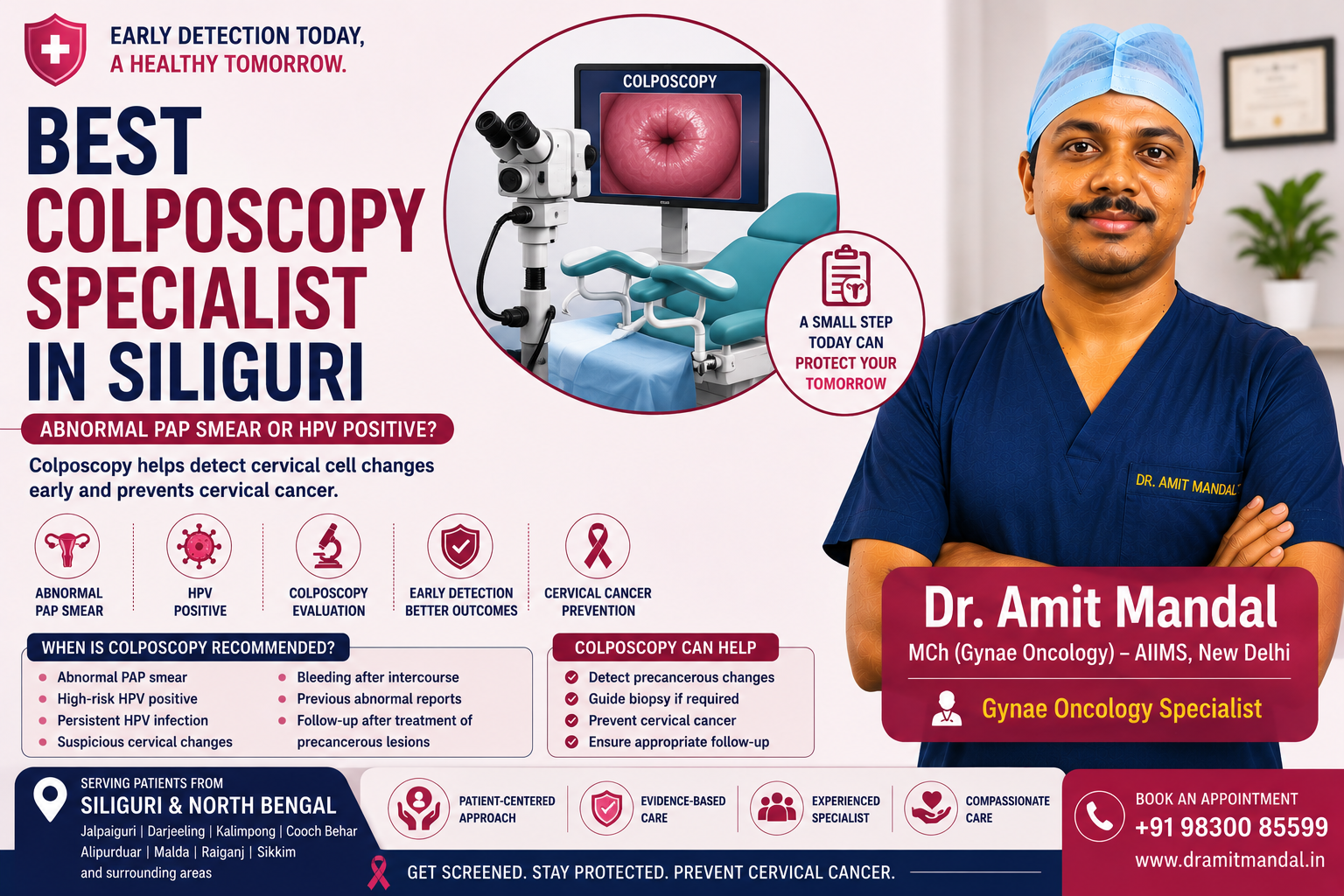
Best Colposcopy Specialist in Siliguri | Abnormal PAP Smear & HPV Care | Dr. Amit Mandal
Posted on: Aug 18, 2026
Best Colposcopy Specialist in Siliguri – Expert Care for Abnormal PAP Smear and HPV by Dr. Amit Mandal
Receiving an abnormal PAP smear report or testing positive for high-risk HPV can be frightening for a woman. One of the first questions patients usually ask is, "Do I have cervical cancer?" The answer is not necessarily. An abnormal screening result does not automatically mean cancer.
In many women, an abnormal PAP smear or HPV-positive report indicates that further evaluation is needed to understand whether there are any abnormal or precancerous changes in the cervix.
This is where colposcopy can become an important part of the evaluation. If you are searching for the Best Colposcopy Specialist in Siliguri, consulting a trained Gynaecological Oncologist can help you understand your report and decide whether further investigation is necessary.
Women from Siliguri and North Bengal, including Jalpaiguri, Darjeeling, Kalimpong, Cooch Behar, Alipurduar, Malda, and surrounding areas, may seek specialist gynecological oncology consultation when they have abnormal cervical screening results.
Dr. Amit Mandal is an MCh-trained Gynaecological Oncologist from AIIMS New Delhi with specialized training and experience in cervical cancer prevention, precancerous cervical lesions, HPV-related conditions, and gynecological cancers.
About Dr. Amit Mandal
Dr. Amit Mandal completed his Masters in Obstetrics and Gynaecology from a reputed Government Medical College in Kolkata. He subsequently underwent specialized training in Gynaecological Oncology at Chittaranjan National Cancer Institute, Kolkata.
He further completed MCh in Gynaecological Oncology from AIIMS New Delhi, one of India's premier medical institutions.
His areas of expertise include:
- Abnormal PAP smear evaluation
- HPV-related cervical abnormalities
- Colposcopy
- Precancerous cervical lesions
- Cervical cancer prevention
- Cervical cancer treatment
- Uterine cancer
- Ovarian cancer
- Vulval and vaginal cancer
- Preventive Gynaecological Oncology
What Is Colposcopy?
Colposcopy is a specialized examination that allows a doctor to examine the cervix more closely after an abnormal cervical screening result or when there is another clinical reason for detailed assessment.
A colposcope is an instrument that provides magnified visualization of the cervix. It does not usually enter the body. The doctor examines the cervical tissue carefully and looks for areas that may require further evaluation.
If a suspicious area is identified, a small biopsy may be taken for laboratory examination.
Why Is Colposcopy Recommended?
Colposcopy may be recommended when a woman's screening or clinical findings indicate that the cervix requires closer assessment.
- Abnormal PAP smear
- Positive high-risk HPV test
- Persistent HPV infection
- Suspicious cervical changes
- Unexplained bleeding after intercourse
- Previous history of cervical precancer
- Follow-up after treatment of cervical abnormalities
The exact reason for recommending colposcopy depends on the patient's age, screening results, previous reports, and clinical history.
Does an Abnormal PAP Smear Mean Cancer?
No. This is one of the most important things women should understand.
A PAP smear is a screening test. Its purpose is to identify abnormal cervical cells that may require further evaluation. Many abnormal results are related to HPV infection or precancerous changes rather than invasive cancer.
Further assessment helps determine what is actually happening.
Depending on the report, a doctor may recommend repeat screening, HPV testing, colposcopy, biopsy, or observation.
What Happens During Colposcopy?
Colposcopy is generally performed as an outpatient procedure. The patient is positioned similarly to a routine gynecological examination.
The doctor uses a speculum to visualize the cervix. The cervix is then examined under magnification using the colposcope. Special solutions may be applied to highlight abnormal areas.
If an area appears suspicious, a small tissue sample may be taken for biopsy.
The procedure is usually relatively quick, although individual experiences can vary.
Why Colposcopy Is Important for Cervical Cancer Prevention
Cervical cancer often develops gradually through precancerous changes. These changes may be detected before invasive cancer develops.
This creates an important opportunity for prevention.
When abnormal cervical changes are identified early, appropriate monitoring or treatment can prevent some lesions from progressing to cervical cancer.
This is one reason cervical screening and timely follow-up should not be ignored.
What Is the Connection Between HPV and Cervical Cancer?
Human Papillomavirus, commonly known as HPV, is strongly associated with cervical cancer. There are many types of HPV, and most infections do not result in cancer.
In many women, HPV infection clears naturally. However, persistent infection with certain high-risk HPV types can cause changes in cervical cells over time.
Women with a positive HPV test should therefore discuss the result with their doctor rather than assuming that they have cancer.
Women looking specifically for HPV-related care in Siliguri can also read Best HPV Specialist in Siliguri.
When Should a Woman Consult a Specialist?
Women should consider specialist evaluation when they have an abnormal screening report or symptoms that require further investigation.
- Abnormal PAP smear
- High-risk HPV positive report
- Persistent HPV infection
- Bleeding after sexual intercourse
- Unexplained vaginal bleeding
- Persistent abnormal vaginal discharge
- Previous cervical precancer
- Suspicious cervical lesion
Bleeding after intercourse can have many causes, but persistent post-coital bleeding should be evaluated rather than repeatedly treated without establishing the cause.
Women concerned about abnormal bleeding can also read Irregular Bleeding After 40: Is It Cancer?.
Can Colposcopy Detect Cervical Cancer?
Colposcopy allows the doctor to closely examine the cervix and identify areas that may require biopsy. If a biopsy is performed, the tissue is examined by a pathologist.
The biopsy result can help determine whether the tissue is normal, shows inflammation, contains precancerous changes, or contains cancerous cells.
Therefore, colposcopy is an important diagnostic step in selected patients, but the final diagnosis depends on the overall clinical assessment and, when required, tissue examination.
What Happens After Colposcopy?
The next step depends on the findings.
- No significant abnormality may require routine follow-up
- Mild changes may require observation and repeat testing
- Precancerous changes may require treatment
- A suspicious biopsy may require further cancer evaluation
The appropriate follow-up interval and treatment depend on the patient's individual report.
Can Cervical Cancer Be Prevented?
Cervical cancer is one of the gynecological cancers for which prevention and early detection can make a major difference.
- HPV vaccination
- Regular cervical cancer screening
- PAP smear testing
- HPV testing when recommended
- Timely evaluation of abnormal screening results
- Treatment of precancerous cervical lesions
HPV vaccination can reduce the risk of cervical cancer associated with the HPV types covered by the vaccine. Screening remains important because vaccination does not eliminate the need for appropriate cervical cancer screening.
Why Choose a Gynaecological Oncologist for Abnormal Cervical Reports?
An abnormal PAP smear or HPV report does not necessarily require cancer treatment. The challenge is identifying which women need further investigation and which women can safely continue with routine follow-up.
A Gynaecological Oncologist has specialized training in cervical cancer prevention, precancerous lesions, cervical cancer diagnosis, and treatment.
This can be particularly useful when the screening result is significantly abnormal, the abnormality persists, or previous treatment has already been performed.
For women travelling from Siliguri to Kolkata, carrying previous PAP smear reports, HPV reports, biopsy results, ultrasound reports, and previous prescriptions can help the specialist understand the complete medical history.
Frequently Asked Questions
Is colposcopy painful?
Colposcopy is generally well tolerated. Some women may experience discomfort during the examination, and a biopsy, if required, may cause brief cramping or discomfort.
Does an abnormal PAP smear mean I have cervical cancer?
No. An abnormal PAP smear can occur because of HPV infection, precancerous changes, inflammation, or other abnormalities. Further evaluation is needed to determine the cause.
Is HPV positive the same as having cancer?
No. HPV infection is common, and most infections do not result in cancer. Persistent infection with certain high-risk HPV types can increase the risk of cervical precancer and cancer.
Who needs colposcopy?
Colposcopy may be recommended for women with certain abnormal PAP smear results, persistent high-risk HPV infection, suspicious cervical findings, or other clinical indications.
Can cervical cancer be prevented?
Cervical cancer risk can be significantly reduced through HPV vaccination, regular screening, early detection, and appropriate treatment of precancerous cervical lesions.
Can women from Siliguri consult Dr. Amit Mandal?
Women from Siliguri and North Bengal can seek specialized Gynaecological Oncology consultation from Dr. Amit Mandal for abnormal PAP smear, HPV-related cervical abnormalities, precancerous lesions, and suspected cervical cancer.
Conclusion
An abnormal PAP smear or positive HPV report should not immediately lead to fear of cancer. It should instead be treated as a reason to understand the report and complete the recommended follow-up.
Colposcopy can provide a closer assessment of the cervix and, when required, allow a biopsy to determine whether abnormal or precancerous changes are present.
For women from Siliguri and North Bengal, specialist evaluation can be particularly useful when HPV infection persists, PAP smear results are abnormal, or a cervical lesion requires further assessment.
Dr. Amit Mandal, an MCh-trained Gynaecological Oncologist from AIIMS New Delhi, focuses on preventive Gynaecological Oncology, cervical cancer screening, precancerous lesions, HPV-related conditions, and gynecological cancer treatment.
The important message is simple: an abnormal screening report is not the same as a cancer diagnosis, but it should never be ignored. Timely specialist evaluation can help identify cervical abnormalities early and provide the appropriate next step.
Recent Posts
-
 Best Uterine Cancer Treatment in Kolkata: Expert Care & Advanced Therapies
-
 Top Cervical Cancer Doctor in Kolkata | Best Treatment & HPV Prevention
-
 Best Vulval Cancer Doctor in Kolkata: When & Where to Seek Help
-
 Endometrial cancer treatment in Kolkata | Dr. Amit Mandal
-
Menopausal Bleeding - A Warning Sign of Uterine Cancer? Symptoms & Treatment
Comments (0)
Post Your Comment